

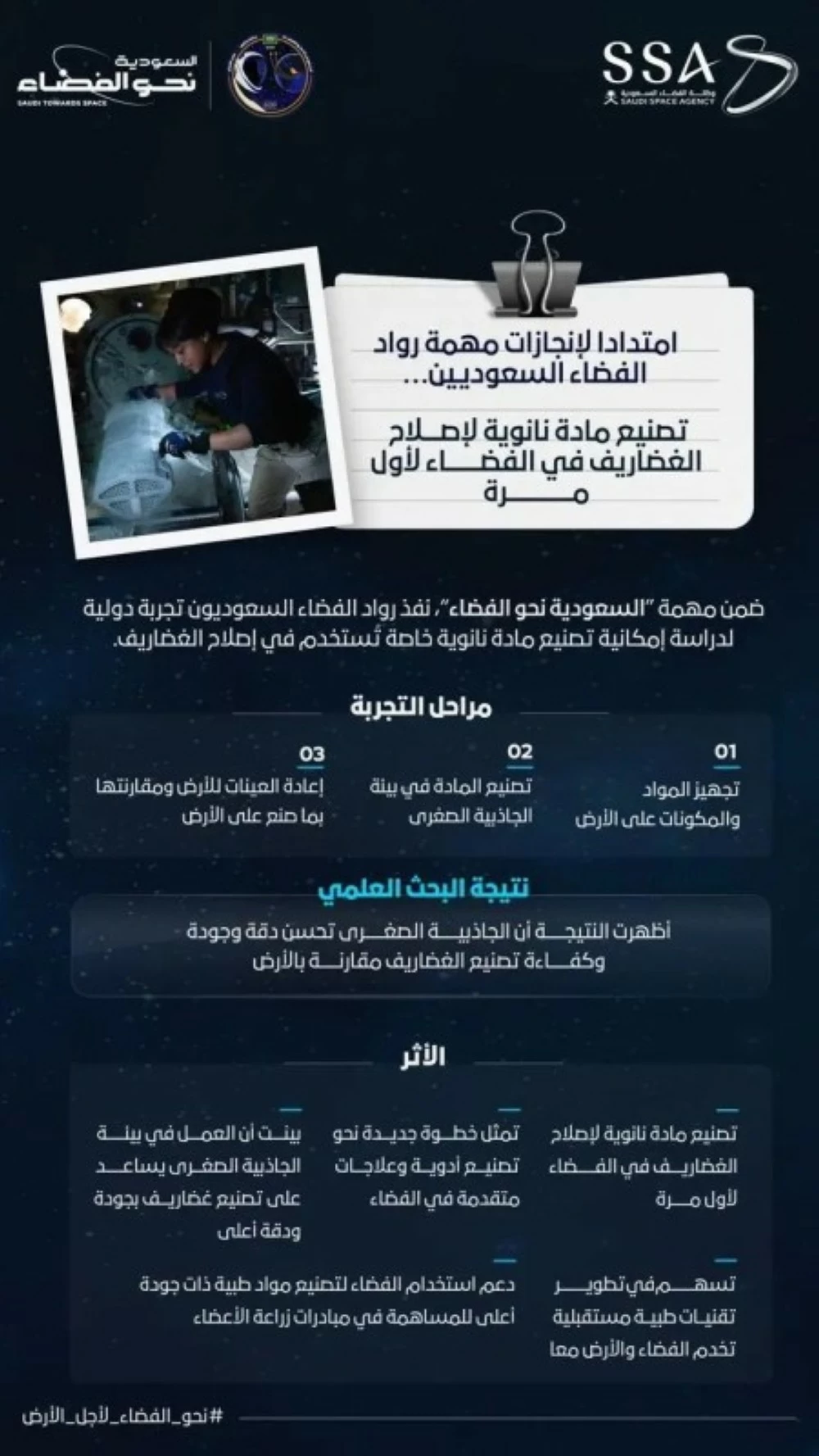
أعلنت وكالة الفضاء السعودية تحقيق إنجاز علمي نوعي يُعدُّ امتداداً لإنجازات المهمة التاريخية السعودية نحو الفضاء (SSA-HSF1)، بعد أن تولى رواد الفضاء السعوديون تنفيذ 19 تجربة علمية على متن محطة الفضاء الدولية، تحولت نتائجها إلى أبحاث ومنجزات علمية، تسهم في تعزيز جودة حياة الإنسان.
وأوضحت أن البحث العلمي الذي قاده كل من العالم يوبينغ تشين وماري آن سنو ضمن تعاون علمي دولي ركز على تطوير مواد حيوية متقدمة لهندسة الأنسجة، فيما تولت رائدة الفضاء السعودية ريانة برناوي تنفيذ التجربة في الفضاء وجمع البيانات في بيئة الجاذبية الصغرى، ما أسهم في تحقيق إنجاز علمي يتمثل في تصنيع مادة نانوية مخصصة لإصلاح الغضاريف في الفضاء لأول مرة، في خطوة تدعم التوجه نحو تصنيع أنسجة وعلاجات متقدمة تسهم في مبادرات زراعة الأعضاء.
ونُشرت نتائج البحث في مجلة نيتشر Nature -إحدى أبرز المجلات العلمية العالمية- وأظهرت النتائج دقة وجودة تصنيع المادة النانوية مقارنة بالتصنيع في بيئة الأرض، ما يعزز توظيف الفضاء بوصفه منصة بحثية لتطوير حلول طبية مبتكرة تخدم صحة الإنسان.
وفي هذا السياق، قالت ريانة برناوي: «تنفيذ التجربة في الفضاء أتاح تصنيع مادة نانوية متقدمة، وإنتاج بيانات موثوقة تدعم تطوير أبحاث علمية تسهم في تحسين حياة الإنسان وخدمة البشرية».
فيما أكّدت الوكالة أن هذه المخرجات العلمية تعكس الدور التكاملي بين العلماء ورواد الفضاء خلال المهمة، وأن هذه النتائج تمثل امتداداً لجهود المملكة في تعظيم العائد العلمي لرحلات الاستكشاف المأهولة، وتحويل مهمات الفضاء إلى منجزات علمية ذات أثر مستدام، بما ينسجم مع مستهدفات رؤية 2030.
The Saudi Space Agency announced a significant scientific achievement that extends the accomplishments of the historic Saudi mission to space (SSA-HSF1), after Saudi astronauts executed 19 scientific experiments aboard the International Space Station, the results of which have transformed into research and scientific achievements that contribute to enhancing the quality of human life.
It was clarified that the scientific research led by both scientist Youbing Chen and Mary Ann Snow, within an international scientific collaboration, focused on developing advanced biomaterials for tissue engineering, while Saudi astronaut Rayana Barnawi carried out the experiment in space and collected data in a microgravity environment, contributing to a scientific achievement represented by the production of a nanomaterial specifically designed for cartilage repair in space for the first time, a step that supports the direction towards manufacturing advanced tissues and treatments that contribute to organ transplantation initiatives.
The research results were published in Nature, one of the most prominent global scientific journals, and the findings demonstrated the precision and quality of the nanomaterial production compared to manufacturing in an Earth environment, enhancing the use of space as a research platform for developing innovative medical solutions that serve human health.
In this context, Rayana Barnawi stated: “Conducting the experiment in space allowed for the production of advanced nanomaterials and the generation of reliable data that supports the development of scientific research contributing to improving human life and serving humanity.”
Meanwhile, the agency confirmed that these scientific outputs reflect the integrative role between scientists and astronauts during the mission, and that these results represent an extension of the Kingdom’s efforts to maximize the scientific return of crewed exploration missions, transforming space missions into scientific achievements with a sustainable impact, in line with the goals of Vision 2030.